
Your Cart is Empty


















Kinesiology tape is the stretchy cotton tape you see on athletes’ shoulders and knees, usually in a bright colour. This page explains what it actually is, what it physically does, what the evidence does and does not support, and how to decide whether it is worth trying - without the marketing.
What is kinesiology tape?

It is an elastic adhesive tape designed to stretch and recoil with the skin. Proworks tape is 95% cotton and 5% spandex, supplied as an uncut 5 metre roll, 5cm wide, with an acrylic adhesive laid down in a wave pattern rather than a solid sheet - which is what lets it breathe and keeps it water resistant.
It is worth being clear what it is not. It is not a bandage, and it is not rigid strapping tape. Rigid zinc oxide tape has no stretch and is used to restrict movement. Kinesiology tape stretches and is used while you move.
Kinesiology tape vs rigid strapping tape
- Kinesiology tape - elastic, cotton/spandex, cut with scissors, worn for days, moves with you.
- Rigid strapping tape - non-elastic, usually hand-tearable, worn for a session, restricts movement.
They do different jobs and are not interchangeable.
How does kinesiology tape work?
Physically, the mechanism is simple. The tape is applied with the skin in a particular position and with little or no tension at the ends. As the limb moves, the tape stretches and recoils, and it lifts and pulls slightly on the skin it is stuck to. That is the whole of what it mechanically does.
On what that achieves, the honest answer is that the research is mixed. A number of proposed physiological mechanisms have been put forward over the years and the evidence for them is not settled. We are not going to tell you otherwise in order to sell tape.
What is not in dispute is that a great many people find it useful, that it is inexpensive, that it is easy to apply yourself, and that it lets you keep moving normally while wearing it.
What people actually use it for

In practice it is applied around joints and muscle groups during sport and training - knees, ankles, shoulders, wrists, calves. Our step-by-step guides cover each of those, filmed in our own studio:
How it is applied

Three things matter more than anything else, and they are the same regardless of body part:
- Clean, dry skin. No lotion or oil - the adhesive is pressure and heat activated.
- Round the corners of every strip. Square corners catch and lift.
- Anchors go down with no stretch. Only the middle of a strip carries tension, and not much of it. More stretch is not better.
Full detail: how to cut and prepare a strip, and wear time, showering, removal and why tape lifts.
Common shapes

- I-strip - a plain rectangle. The default.
- Y-strip - split up the middle so two tails pass either side of a muscle.
- Fan - several thin tails from one anchor.
Choosing tape
Does colour make a difference?
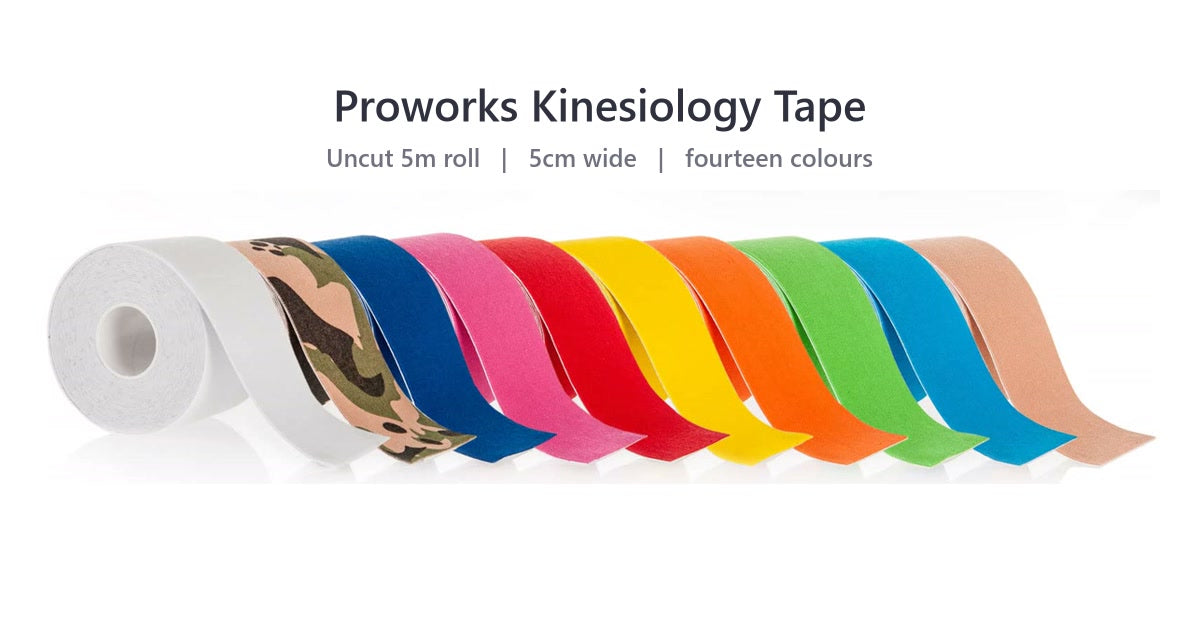
No. Colour has no effect on how the tape performs. Proworks offers fourteen so you can match your kit or pick one you like.
Pre-cut or uncut?
Pre-cut strips are convenient but fix you to one length and shape. An uncut roll costs less per application and lets you cut to the area you are actually taping. Proworks supplies uncut 5m rolls.
How much do you need?
A wrist or calf strip is typically 20–30cm, so a 5 metre roll covers a good number of applications.
Who should be careful with it
Do not apply tape to broken, irritated or infected skin. If you know your skin reacts to adhesives, test a small piece first - Proworks tape is latex free, but adhesives vary. If pain is severe, followed an injury, or is not settling, see a qualified healthcare professional rather than taping over it.
Questions people ask
How long can you leave it on?
Usually several days. More on wear time and removal.
Can it get wet?
It is water resistant, not waterproof. Showering and sweat are fine; long submersion shortens its life.
Can you apply it yourself?
Yes, for most areas. The wrist and calf guides are both filmed self-applied.
Does it need to be cut with scissors?
Yes. This is a cotton and spandex weave, not a hand-tearable rigid tape.
Proworks kinesiology tape
Uncut 5m roll, 5cm wide, 95% cotton / 5% spandex, water resistant, latex free, fourteen colours.
This tape is a support product, not medical advice. If your pain is severe, followed an injury, or is not settling, speak to a qualified healthcare professional. Do not apply tape to broken, irritated or infected skin.